
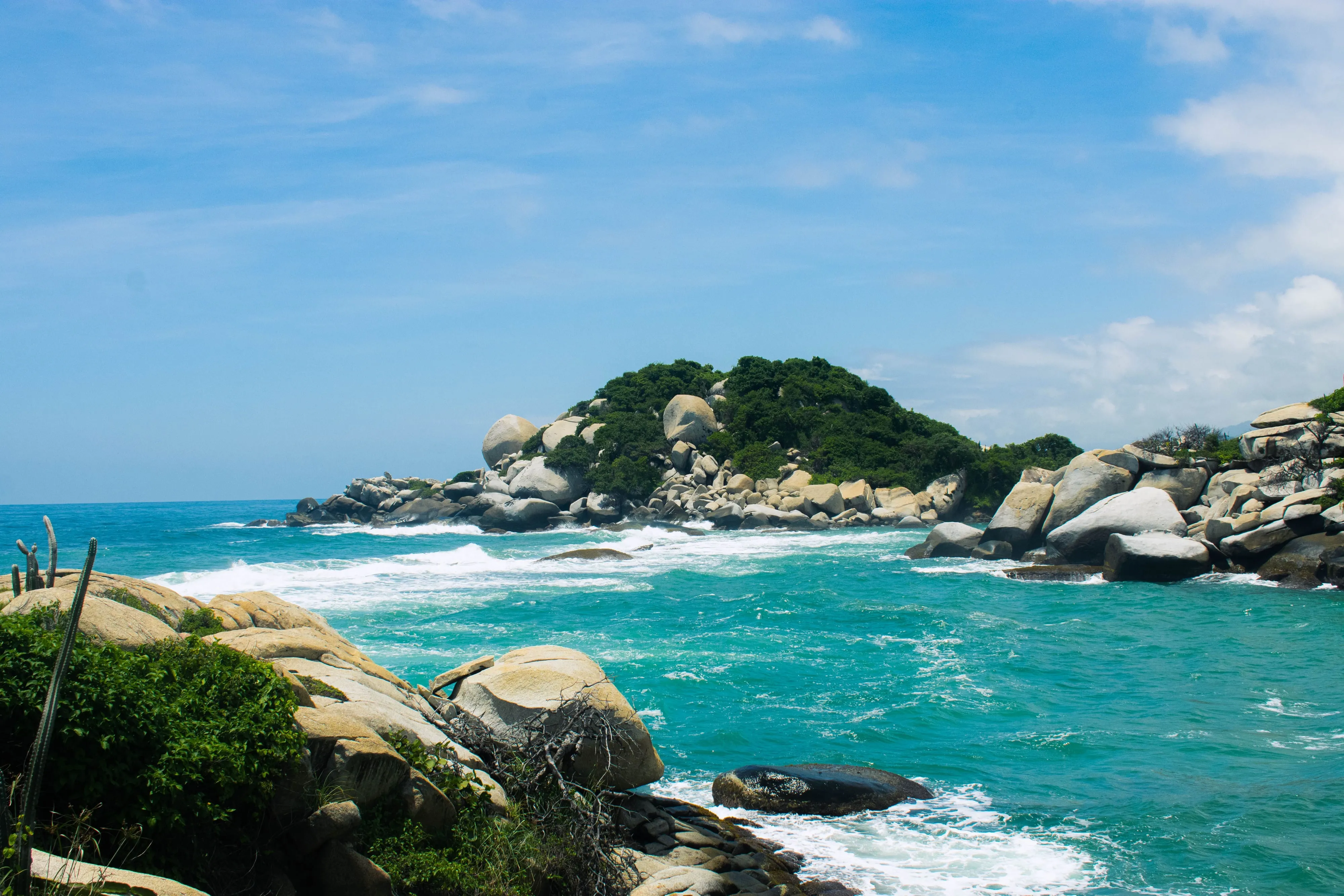
Tayrona is the reason many people book a flight to Colombia’s Caribbean coast. Jungle runs straight down to the sea, boulders the size of houses frame beaches with names travelers trade like secrets, and the Sierra Nevada de Santa Marta, the world’s highest coastal mountain range, rises behind it all. It is also a park with more rules, closures, and moving parts than any other stop on a typical Colombia itinerary, and 2026 has been an unusually eventful year for it. This guide covers what you need to know to plan a visit: how the park works, what it costs, the dates it closes, and the practical details that make the difference between a magical day and a frustrating one.
Tayrona sits about 32 kilometers east of Santa Marta, which is the natural base for a visit, along the coastal road toward Palomino.
First, Check the Park Is Open
This is not boilerplate advice with Tayrona. The park closes to tourism three times every year, and 2026 has also seen an unscheduled closure, so verifying the current status before you build an itinerary around it is genuinely necessary.
The scheduled closures. Three times a year the park shuts completely under the “Respira Tayrona” program, so its ecosystems can recover and the four indigenous peoples of the Sierra Nevada, the Kogui, Wiwa, Arhuaco, and Kankuamo, can carry out spiritual and harmonization ceremonies in their ancestral territory. The 2026 closure dates announced by Parques Nacionales Naturales were February 1 to 15 and June 1 to 15, both now past, and October 19 to November 2, which is still ahead. If your trip falls in late October, plan around it; the closure covers the entire park.
2026’s unscheduled closure. Tayrona’s access has been genuinely unsettled this year. In mid-February 2026, days after the scheduled closure ended, the parks authority closed the park again, citing security threats connected to a confrontation over illegal construction and criminal influence in the park’s tourism economy, against a backdrop of a territorial conflict between armed groups operating in the wider region. The park reopened on March 5, 2026 under what the government called special surveillance, with Carabineros police units posted at access points and along the main trails. In mid-June 2026 the U.S. Embassy in Bogotá issued a security advisory about armed conflict affecting roads near the park. As of late July 2026, Parques Nacionales states that the Calabazo, Zaino, Palangana, and Bahía Concha sectors are all open to visitors and that the park is operating normally, but the situation has shifted quickly more than once this year.
We tell you this history not to alarm you but because it is the practical reality of planning around Tayrona in 2026: conditions can change with little notice. Check the Parques Nacionales de Colombia channels or ask your accommodation in Santa Marta for the current status a few days before you go, and see what the foreign travel advisories currently say about the region rather than relying on any fixed statement, ours included. As of July 2026, Santa Marta and Tayrona do not fall inside the areas that the UK, US, Canadian, or Australian advisories name in their advise-against lists, but those advisories are updated through the year and are the right place to look, not a blog post. Our Colombia safety guidelines apply here as everywhere.
What It Costs in 2026
Tayrona is one of Colombia’s more expensive tickets, and foreigners pay a higher rate than residents. As of 2026, Parques Nacionales charges non-resident foreign visitors COP 81,000 (USD 26) off-season and COP 96,500 (USD 31) in peak season. The smaller Bahía Concha sector charges a flat COP 43,500 (USD 14) all year.
Peak season is wider than most people assume, and it is worth checking against your dates before you budget. The park counts December 1 to January 31, June 1 to July 31, Holy Week from Palm Sunday to Easter Sunday, long weekends with a public holiday Monday, and the school break week before the Columbus Day holiday. All of July is peak, not just the first half.
On top of the ticket, everyone pays for mandatory accident insurance with visitor assistance, required under Resolution 273 of 2024 and bought from insurers the park endorses; budget around COP 7,000 (USD 2) per person per day, though the park does not publish the rate itself. Bringing a vehicle costs COP 19,000 (USD 6) for a car or COP 13,500 (USD 4) for a motorcycle. Fees are revised each year, so treat these as a close guide and confirm the current figure when you buy.
You can pay in cash or by card at the entrances, but there are no ATMs at or near the park, so arrive with the pesos you will need for food, boats, and lockers inside. In peak weeks the park’s daily visitor caps can bite, and buying your ticket online in advance, or arriving early, saves you the risk of being turned away at midday.
One rule that surprises people: the yellow fever card. Since a parks-authority circular issued in April 2025, during Colombia’s yellow fever health emergency, visitors are required to show proof of yellow fever vaccination to enter national parks, Tayrona included, and the vaccine must have been administered at least 10 days before your visit. Enforcement at the gate has been inconsistent in practice, but the requirement is official, and a same-week jab does not satisfy it, so sort this out before you fly. Carry the international certificate. Our entry documents guide covers the paperwork side of a Colombia trip more broadly.
The Entrances, and Which One You Want
Tayrona is not one gate but four sectors, and picking the right one shapes your whole day.
El Zaino is the main entrance, the one most people mean when they say they went to Tayrona. From here a shuttle or a 40-minute walk brings you to Cañaveral, and the classic trail continues on foot through jungle and over boulders to Arrecifes, La Piscina, and Cabo San Juan, the park’s most famous beach, about two hours of walking in heat and humidity. This is the Tayrona of the photographs.
Calabazo is the quieter hiking entrance a little closer to Santa Marta. From it a more demanding trail climbs through jungle and drops to Playa Brava, one of the park’s emptiest beaches, and can continue on to Cabo San Juan, making a superb one-way traverse for fit walkers who exit at El Zaino. Note that Pueblito Chairama, the ancient Tairona stone settlement this trail once passed, has been closed to tourism since 2019 at the request of the region’s indigenous peoples, and it remains closed; do not book anything that promises to take you there.
Palangana is the road entrance for the Neguanje sector and Playa Cristal, a calm, coral-fringed beach usually reached by a short boat hop, popular as a day trip with snorkeling.
Bahía Concha is the closest sector to Santa Marta, a broad beach reached by a rough road, with its own cheaper ticket. It is a beach day rather than a jungle experience, and a good option with small children.
Beaches, Trails, and the Swimming Rule That Matters
The walk from Cañaveral to Cabo San Juan strings together the park’s greatest hits: the wild, palm-backed sweep at Arrecifes, the sheltered pool of La Piscina, and finally Cabo San Juan with its twin coves and the hammock hut on the rock between them. Wildlife is part of the deal on the trail, with caimans in the lagoons and monkeys, agoutis, and spectacular birdlife in the canopy; the park sits in one of the most biodiverse corners of the country, which is exactly why it earns its place on any nature and wildlife itinerary. Walk in the early morning and you will have stretches of the trail nearly to yourself; more ideas for the region’s walking are in our trekking and hiking guide.
Now the rule that matters more than any other in this park: not every beautiful beach in Tayrona is a swimming beach, and the closed ones are closed because people have drowned there. The currents and riptides at Arrecifes in particular are lethal, and signs along the sand say so plainly. Swim only where swimming is allowed, which includes La Piscina, the coves at Cabo San Juan, Playa Cristal, and Bahía Concha, and respect the flags and the rangers on the day, since conditions move. If a beach is empty of swimmers, there is a reason.
For a wider look at the coast’s options beyond the park, our beaches and islands guide puts Tayrona alongside the alternatives.
Staying Overnight, or Not
Day trips work, but Tayrona rewards a night. Sleeping options inside the park run from hammocks and tents at Cabo San Juan and the Arrecifes-area campsites, basic but unforgettable when you wake to the sound of the surf, up to the comfortable Ecohabs cabins near Cañaveral at a very different price point. Overnighting lets you see the beaches before the day-trip wave arrives around late morning and after it recedes in the afternoon, which is when the park is at its best.
If you prefer a bed and a shower, the strip of guesthouses and hostels along the road outside El Zaino, or a base in Santa Marta itself, lets you be at the gate when it opens. Hours run by sector and by season rather than park-wide, and the cut-off that matters is the last admission, not the closing time. Parques Nacionales currently publishes these:
| Sector | Peak season | Off-season |
|---|---|---|
| El Zaino | Entry 7am to 3pm, out by 6pm | Entry 8am to 5pm, out by 5pm |
| Calabazo | Entry 6am to 1pm, out by 5pm | Entry 6am to 1pm, out by 5pm |
| Palangana | Entry 7am to 2pm, out by 5pm | Entry 8am to 3pm, out by 5pm |
| Bahía Concha | Entry 7am to 2pm, out by 6pm | Entry 7am to 3pm, out by 5pm |
Calabazo shuts its gate at 1pm year round, which catches people out, and it is the entrance for the long traverse that needs the most daylight. Build your day around an early start regardless; the heat argues for it as much as the crowds do.
Getting There
From Santa Marta’s public market area, frequent local buses run along the coastal road and drop you at any of the entrances in under an hour for a few thousand pesos, with El Zaino about 32 kilometers out, roughly 45 minutes by car. Taxis and ride apps do the run quickly, and any hotel can arrange a driver. Coming from the other direction, buses between Palomino and Santa Marta pass the gates the same way. There are also boat services to Cabo San Juan from Taganga in season, a wet and bumpy shortcut that skips the walking entirely; check locally whether they are running, as the service is sea-state dependent.
For the wider logistics of reaching Santa Marta from the rest of Colombia, see the getting there section of our Santa Marta guide.
Quick Answers
- How long do I need? One full day covers the classic El Zaino to Cabo San Juan circuit. A night in the park, or two, makes it a highlight rather than a march.
- When should I go? The dry months of December to March and July to August are most reliable, but the park is open, and beautiful, most of the year. Just mind the closure calendar above, and remember the October 19 to November 2, 2026 closure.
- Is it crowded? At Cabo San Juan in high season, yes. Early starts, overnights, and the Calabazo or Neguanje sectors are the escape hatches.
- What should I bring? More water than you think, cash, sun protection, insect repellent, decent footwear for the roots and boulders, your passport, and your yellow fever certificate.
Sources
- Parques Nacionales Naturales de Colombia: sala de prensa (closure and reopening announcements, 2026)
- Parques Nacionales: Tayrona operating with all sectors open to visitors (status, checked July 29, 2026)
- Parques Nacionales: PNN Tayrona park page (park status, per-sector schedule, admission fees, and insurance requirement, checked July 29, 2026)
- Infobae: Tayrona June 2026 closure and Respira Tayrona
- Infobae: reopening with access restrictions, June 16, 2026
- The Bogotá Post: February 2026 closure over security threats
- Colombia One: park reopens under special surveillance, March 5, 2026
- UK FCDO Colombia travel advice