
Updated
On this page
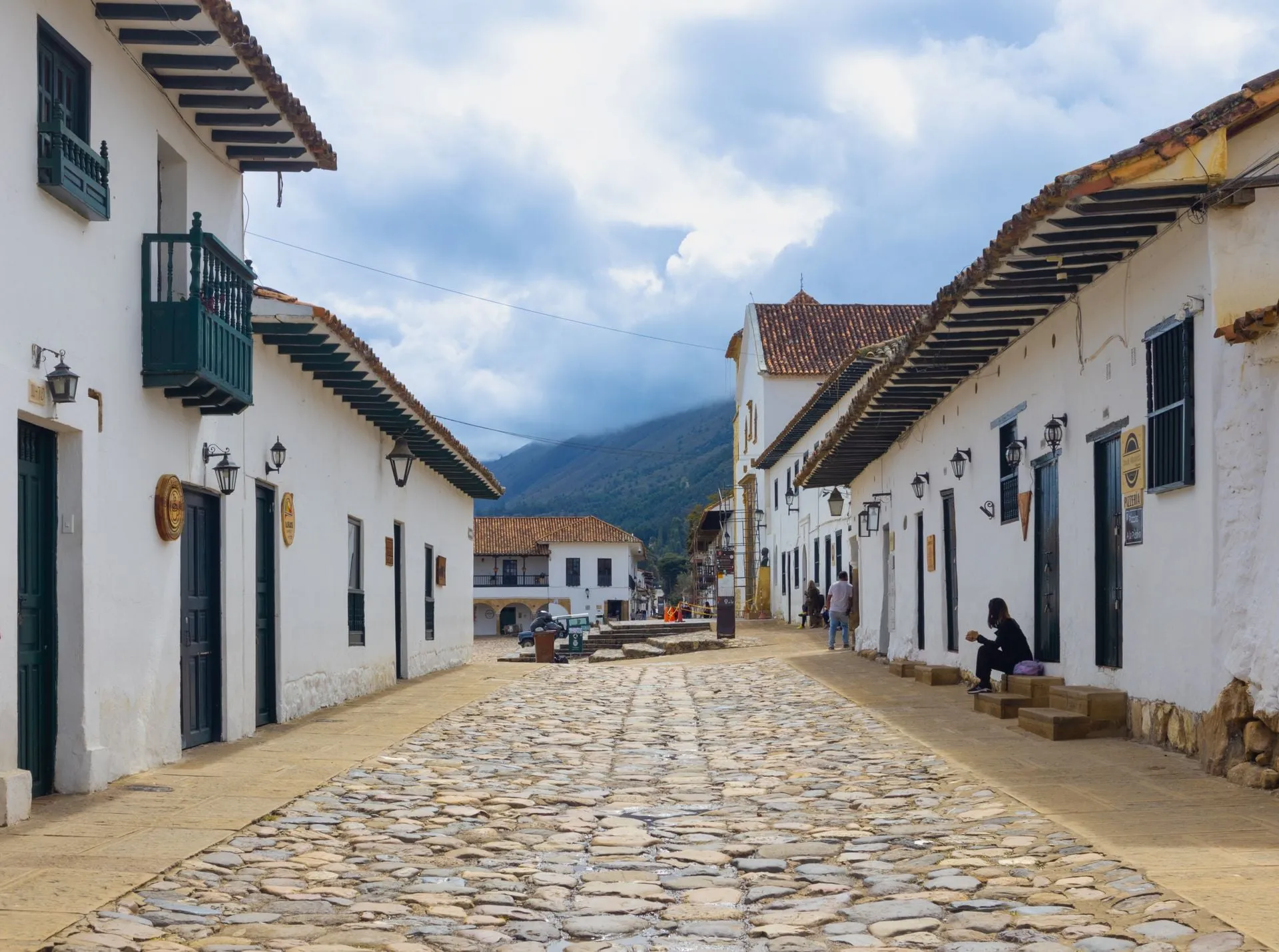
Most colonial towns in Latin America have a pretty square. Villa de Leyva has a plaza so large it reads as slightly absurd: a vast expanse of rough cobbles, ringed by low whitewashed buildings, with a small Mudéjar fountain marooned in the middle of it and mountains visible over the rooftops. It is one of the largest squares in the Americas and it has essentially no cars on it.
The town was founded in 1572 and then, usefully for us, more or less stopped. It was declared a national monument in 1954, which froze the whitewashed walls, the wooden balconies, and the cobbles that punish every shoe you own. Three and a half hours from Bogotá, in a dry valley at around 2,150 meters, it is the capital’s standard weekend escape and one of the few places in Colombia where the phrase “colonial town” is doing no marketing work at all.
Getting There
Buses leave Bogotá’s Salitre terminal frequently, run via Tunja, and take three and a half to four and a half hours depending entirely on how long it takes to get out of Bogotá. Fares sit in the region of COP 30,000 to 45,000 (about USD 9 to 14) one way. Villa de Leyva’s terminal is a five to ten minute walk from the Plaza Mayor, which is a rare kindness.
Driving takes about the same and gives you the countryside, which is worth having. Two stretches to avoid if you possibly can: Friday afternoon out of Bogotá and Sunday afternoon back into it. This is the single most popular weekend destination for a city of eight million people, and the road behaves accordingly.
Our guide to Bogotá covers the capital end, and getting around Colombia has the wider intercity picture.
The Town Itself
You can walk all of it in a morning, and you should, because that is the point.
The Plaza Mayor is the reason people come. Go twice: once in daylight and once after dark, when the buildings are lit and the crowds have thinned. The parish church on its north side dates from the early seventeenth century. There is no shade on the plaza, so a hat earns its place at midday.
The cobbles are not decorative. They are large, uneven, rounded river stones, and they are genuinely hard to walk on. Bring shoes with a sole and some grip, and reconsider anything with a heel or a thin sole. Our Colombia packing list has the wider footwear argument.
The side streets are where the town is most itself: courtyard restaurants, small museums, workshops, and a handful of very good places to eat that would not be out of place in Bogotá.
Casa Terracota sits a short walk or a few minutes’ drive from the center, a house built entirely from fired clay, and it is the one modern building in the area anyone talks about. Entry has been running around COP 35,000 to 50,000 (about USD 11 to 16) depending on the day and season.
The Valley Around It
This is what turns one night into two.
Fossils. The valley was a shallow sea in the Cretaceous, and it is full of marine reptiles. El Fósil is a museum built around a near-complete pliosaur left in the ground where it was found, which is a considerably better experience than the same animal behind glass in a city. Several smaller paleontological sites and museums sit along the same road.
El Infiernito. A Muisca site of standing stones that functioned as an astronomical marker, one of the very few pre-Columbian sites of its kind you can visit in Colombia. Its unfortunate colonial-era nickname says more about the priests who named it than about the people who built it. Our history and heritage page sets it in context.
Ráquira, about half an hour away, is Colombia’s ceramics town, and the single best place in the country to buy pottery. It is unapologetically a shopping stop and it is very good at it. Our artisanal crafts page covers what is worth buying across Colombia and how to tell workshop pieces from imports.
Pozos Azules, a set of startlingly blue ponds in dry scrub just outside town, is a fifteen-minute stop rather than an afternoon, and a heavily photographed one.
Santuario de Fauna y Flora Iguaque is the serious walk: a climb to a high sacred lake that Muisca cosmology holds as the origin of humanity. It is a demanding day at altitude, the páramo weather is unforgiving, and access can be restricted, so check before you commit. Our trekking and hiking page covers what Colombian páramo hiking involves.
When to Go
Midweek, if you have the choice. This is the strongest single piece of advice about Villa de Leyva. On weekends and Colombian public holidays the town fills with Bogotanos, prices climb, restaurants need booking, and the plaza is busy. Midweek it is close to empty and much more like the place the photographs promise.
The valley is dry, which is unusual for the Colombian Andes, so it dodges the worst of the rain that shapes travel elsewhere in the country. Days are warm and sunny, nights are cold, and the sun at this altitude is strong regardless of temperature. Our best time to visit Colombia covers the national picture.
The town has a busy festival calendar, including a kite festival in August and a lights festival in December. Both are genuinely worth timing a trip around, and both mean booking well ahead.
Where It Fits
Villa de Leyva is most often done as a two-night trip out of Bogotá, and that works well. If you are heading north it also sits reasonably on the way to Santander, which makes a natural pairing with Barichara, the other great preserved colonial town, for anyone who wants both.
What it is not is a base for the rest of Colombia. It is a destination in its own right, in a quiet corner of Boyacá, and the honest framing is that you go there to slow down for two days rather than to see something on the way to somewhere else.
Fares and entry prices checked September 2026. Bus fares and museum entries change, so treat these as planning figures.
Sources
- Bogotá to Villa de Leyva bus routes, schedules, and fares
- Colombia Travel (ProColombia), Villa de Leyva: national monument status, and the Plaza Mayor at 14,000 square meters
Frequently Asked Questions
How do you get from Bogotá to Villa de Leyva?
Buses run from Bogotá's Salitre terminal via Tunja and take roughly three and a half to four and a half hours depending on traffic leaving the city, with fares in the region of COP 30,000 to 45,000 one way. Villa de Leyva's bus terminal is a five to ten minute walk from the Plaza Mayor. Driving takes about the same time, and Friday afternoons out of Bogotá and Sunday afternoons back are the two stretches to avoid.
How many days do you need in Villa de Leyva?
Two nights is the sweet spot. One full day covers the town itself, which is small enough to walk, and a second gets you out to the fossil sites, the Muisca observatory, Ráquira, or a hike. A single night works if you only want the plaza and a good dinner, but the countryside around the town is half the reason to come.
Is Villa de Leyva worth visiting?
If you like colonial architecture, it is the best-preserved example in Colombia and its Plaza Mayor, at 14,000 square meters, is the largest in Colombia. The surrounding valley adds marine fossils, a pre-Columbian astronomical site, and a national park, which is an unusual combination for one small town. It is very popular with Bogotanos on weekends, so a midweek visit is a different and better experience.
What is the weather like in Villa de Leyva?
It sits at around 2,150 meters in a dry valley, so it is milder and considerably drier than Bogotá, with warm sunny days and cold nights year-round. Pack layers and something warm for the evening. The high-altitude sun is strong even when the air is cool.