
Updated
On this page
San Andrés is closer to Nicaragua than to Colombia. It sits about 750 kilometers off the Colombian mainland and roughly 200 off the Nicaraguan coast, and it is Colombian in the way that reflects a long and contested Caribbean history rather than any geographical logic.
That distance is the whole point of the place. The archipelago is home to the Raizal people, who are Afro-Caribbean, historically Protestant rather than Catholic, and speak an English-based Creole alongside Spanish. The food, the music, the churches, and the architecture are Caribbean in a sense that Cartagena, for all its coastline, is not. You are not going to a Colombian beach. You are going somewhere else that happens to be Colombian.
The Tourist Card You Cannot Skip
Start here, because it catches people out at the airport.
Every non-resident traveler needs the tarjeta de turismo to enter the archipelago, arriving by air or by sea. For 2026 it costs COP 153,000 (about USD 48), up from COP 146,000. Most of the money goes to social programs for island residents and the rest to tourism development and public infrastructure. Children under seven, people born in the archipelago, and accredited residents are exempt.
You normally buy it at the airline counter before boarding, and it is also sold at airports, authorized travel agencies, tourism offices, maritime transport offices, and through a digital channel run by the departmental government. It is checked on arrival and again when you leave, so keep it with your passport rather than in your luggage.
Budget it as part of the flight rather than a surprise on the day, and carry the cash. Our guide to money in Colombia covers why cash matters more here than you would expect for a beach destination.
San Andrés
The island is small, roughly 26 square kilometers, and you can drive the coastal road around it in about an hour. That scale shapes everything: you do not need a plan so much as a scooter or a golf cart and a few days.
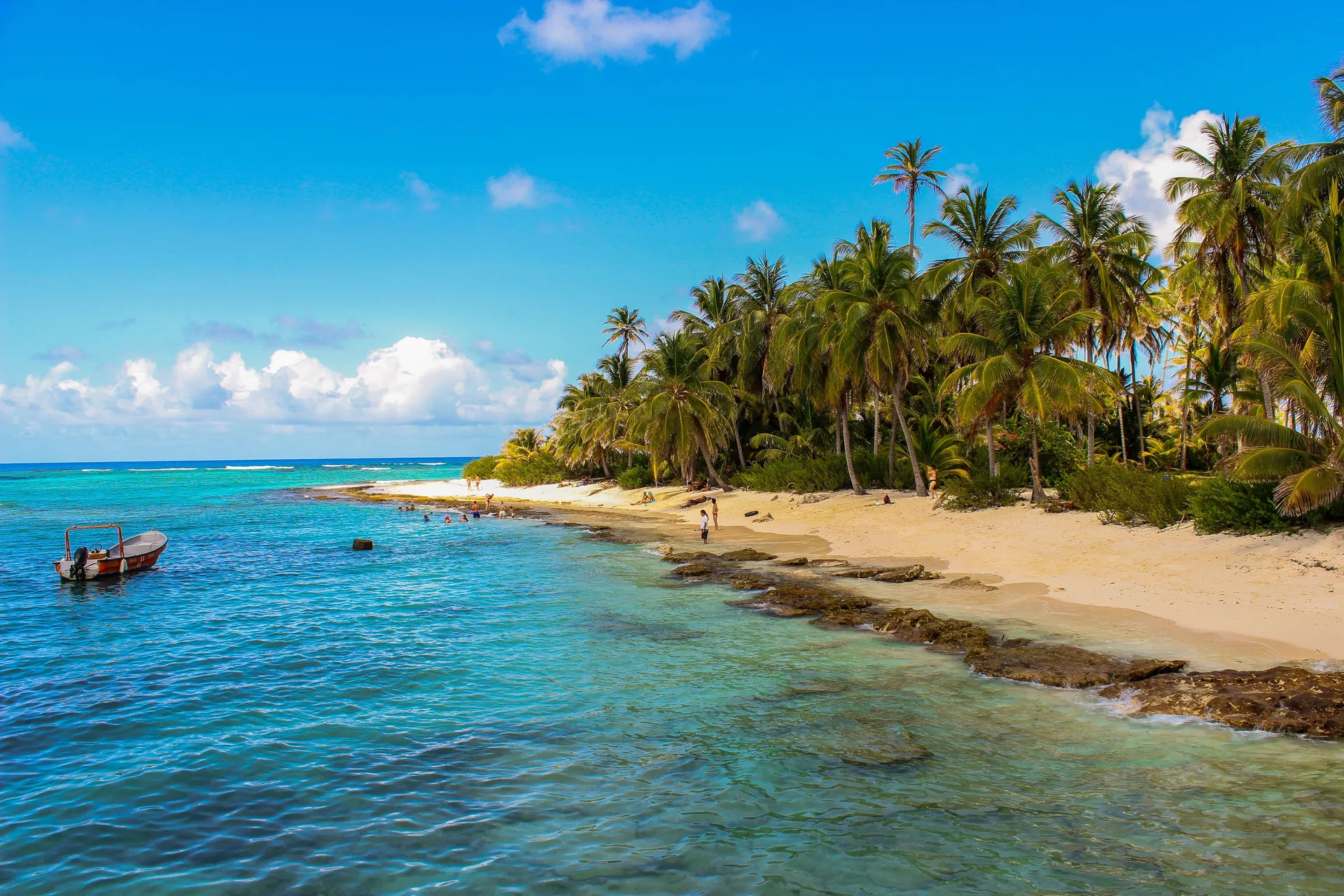
The sea of seven colors is the marketing line and it is, annoyingly, accurate. The shallow reef flats produce genuinely distinct bands of turquoise, green, and blue, and the effect is most obvious from the east coast road and from the air on landing. Look out of the window on approach.
Johnny Cay is the standard boat trip, a small island just offshore with a beach and a great deal of company. Acuario and Haynes Cay are the snorkeling stops, in water shallow enough to stand in. All three are usually sold together as a half day, and all three are busy.
The reef is the real draw. San Andrés sits within the Seaflower Biosphere Reserve, one of the largest protected marine areas in the Caribbean, and the diving is the best reason to come. Wall dives, wrecks, and consistently warm water. If you dive, this is the part of the trip to build around.
La Loma is the inland Raizal heart of the island, with the Baptist church that has stood since the nineteenth century, and it is where the archipelago’s own culture is most visible rather than packaged.
Hoyo Soplador, the blowhole at the southern tip, and La Piscinita and West View on the west coast are the standard stops on a circuit of the island. The west side has the better snorkeling from shore.
Providencia
Providencia is what people mean when they say San Andrés has become too developed. It is smaller, quieter, mountainous rather than flat, and considerably harder to reach, which is exactly why it stays that way.
Getting there matters more than anything else you plan. Satena flies from San Andrés in about twenty minutes on small aircraft, and seats go early in peak season. The catamaran takes around three to four hours, and fares vary by operator, so compare a couple and buy the return at the same time. Sailings depend on the weather, so confirm your departure the day before. The crossing is open water and has a firm reputation for roughness; if you are at all prone to seasickness, pay for the flight.
Once there, the island’s draws are Crab Cay, the reef, the hike up to The Peak, and the beaches at Southwest Bay and Manzanillo, which are among the quietest developed beaches in the Colombian Caribbean.
One piece of context worth carrying. Providencia was hit directly by Hurricane Iota in November 2020, which destroyed or damaged the overwhelming majority of the island’s buildings. The reconstruction has been long and contested, and it is part of the recent lived experience of everyone you will meet. It is not a reason to avoid the island, and visitor spending is part of what sustains it, but it is worth understanding rather than arriving oblivious.
Practicalities
- It is more expensive than the mainland. Nearly everything is shipped or flown in, and the tourist card, boat trips, and dive packages add up faster than a Cartagena beach week.
- Cash matters. Card acceptance is better on San Andrés than Providencia, but neither is a place to rely on it, and ATMs on Providencia are limited.
- Book Providencia’s flights early. This is the single most common failure point in an island itinerary.
- Reef-safe sunscreen. You are in a biosphere reserve and snorkeling over living coral.
- Getting around San Andrés is by scooter, golf cart, or the cheap island buses that circle the coastal road. Golf carts are the tourist default and rent by the day.
- Safety on the islands. Canada’s travel advice, which rates most of Colombia at “exercise a high degree of caution”, rates the island of Providencia and the town of San Andrés at “take normal security precautions”, its lowest level; the UK FCDO’s advice does not single out the islands, and they are not among the US State Department’s Level 4 areas (all checked October 1, 2026). The practical risks are mostly at sea and in the sun: use boat operators who provide life jackets, swim only where the water is calm and others are swimming, and keep valuables out of sight on busy beaches. For emergencies, dial 123, as on the mainland.
- The wetter months run roughly October to December. Hurricane season on this part of the Caribbean broadly spans June to November, which is worth factoring in for both islands. Our guide to the best time to visit Colombia has the national picture.
Where It Fits a Trip
San Andrés is a flight from the mainland, not a stop on a road route, and that shapes how it fits. It works best as a distinct end-of-trip week rather than something wedged between Cartagena and Medellín, and it pairs naturally with nothing else because it is nothing else’s neighbor.
The honest framing: San Andrés is developed, busy in season, and genuinely beautiful underwater. Providencia is the quiet one and takes real effort to reach. If you have a week and you want the Caribbean, do both and give Providencia the larger half. If you have three nights, San Andrés alone is a reasonable trip and the diving justifies it.
For where these sit against Colombia’s other coastlines, our beaches and islands page covers the alternatives on the mainland Caribbean and the Pacific.
Tourist card price and logistics checked October 1, 2026. The tourist card is repriced annually, so confirm the current figure before you fly.
Sources
- Portafolio: the 2026 price of the San Andrés tourist card and how it breaks down
- El Espectador: the new San Andrés entry card price for 2026 and how to buy it
- El País: the tourist card is compulsory to enter San Andrés
- Government of Canada: Travel advice for Colombia (risk levels for Providencia and San Andrés town; updated September 29, 2026; checked October 1, 2026)
- UNESCO: Seaflower Biosphere Reserve
Frequently Asked Questions
Do you need a tourist card for San Andrés?
Yes. Every non-resident traveler needs the tarjeta de turismo to enter the archipelago, whether arriving by air or by sea, and it is checked on arrival and again on departure. For 2026 it costs COP 153,000. Children under seven, people born in the archipelago, and accredited residents are exempt. You normally buy it at the airline counter before boarding.
How do you get from San Andrés to Providencia?
Two ways. Satena flies the route in about twenty minutes, and seats sell out well ahead in peak season. The catamaran takes around three to four hours, with fares that vary by operator, so compare a couple. The crossing has a firm reputation for being rough, so if you are prone to seasickness the flight is worth the money.
Is San Andrés part of Colombia?
Yes, though it sits about 750 kilometers from the Colombian mainland and roughly 200 kilometers off Nicaragua. It is Colombian territory with its own distinct history and culture: the islands are home to the Raizal people, who are Protestant, Afro-Caribbean, and speak an English-based Creole, which makes the archipelago culturally unlike anywhere on the mainland.
How many days do you need in San Andrés and Providencia?
Three or four nights on San Andrés covers the island, the reef, and the cays comfortably, since you can drive its perimeter in about an hour. Providencia deserves at least three nights of its own given the effort of getting there, and most people who go wish they had stayed longer. Doing both properly is a week.